

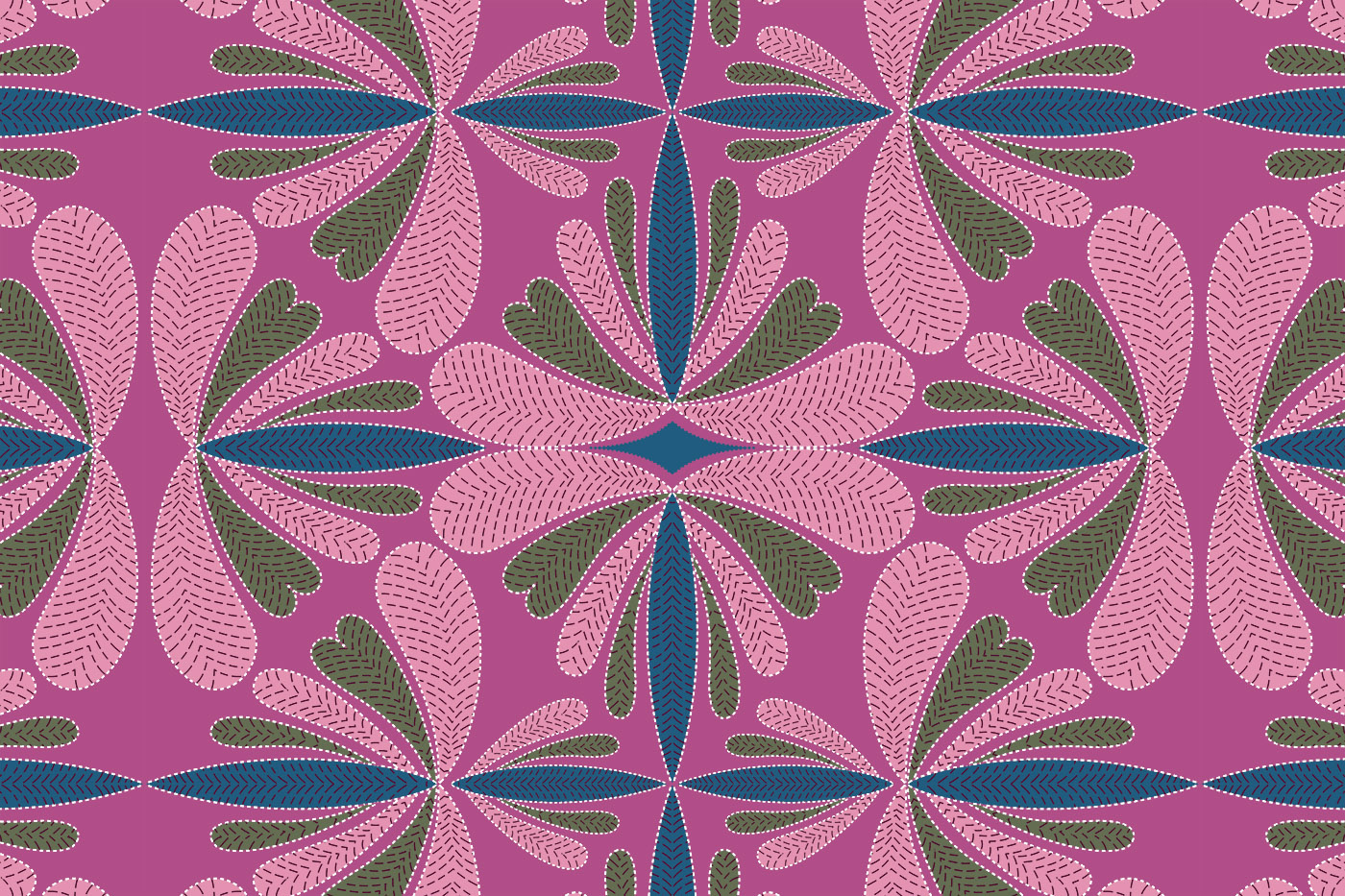

Bagru Printing: History, Process, Colours & Traditional Textile Design
Explore Bagru Textile Designs
Production-ready Bagru-inspired patterns for fashion, fabric printing and contemporary textile projects — rooted in the centuries-old craft of indigo, geometry and hand-block printing.
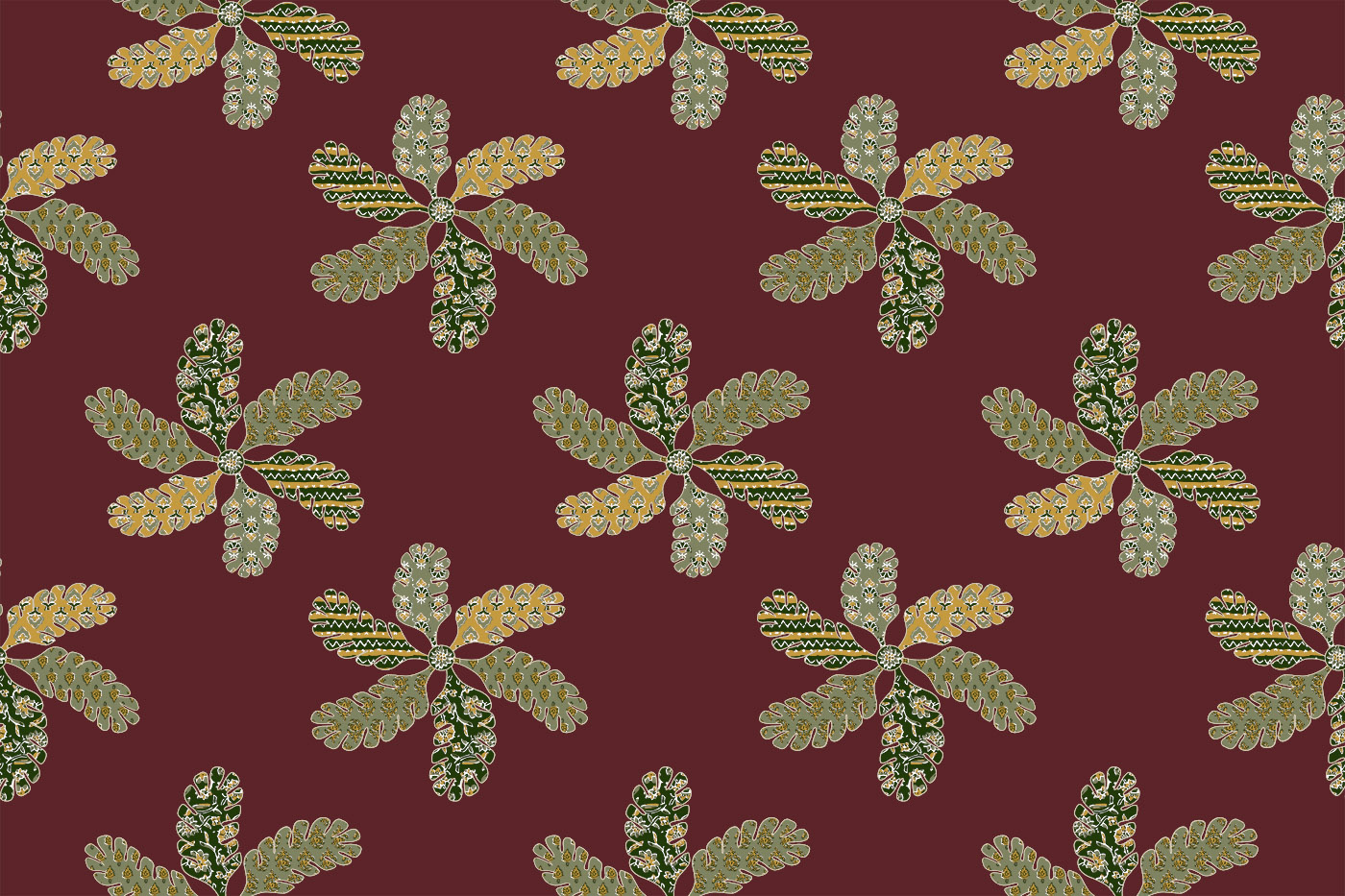
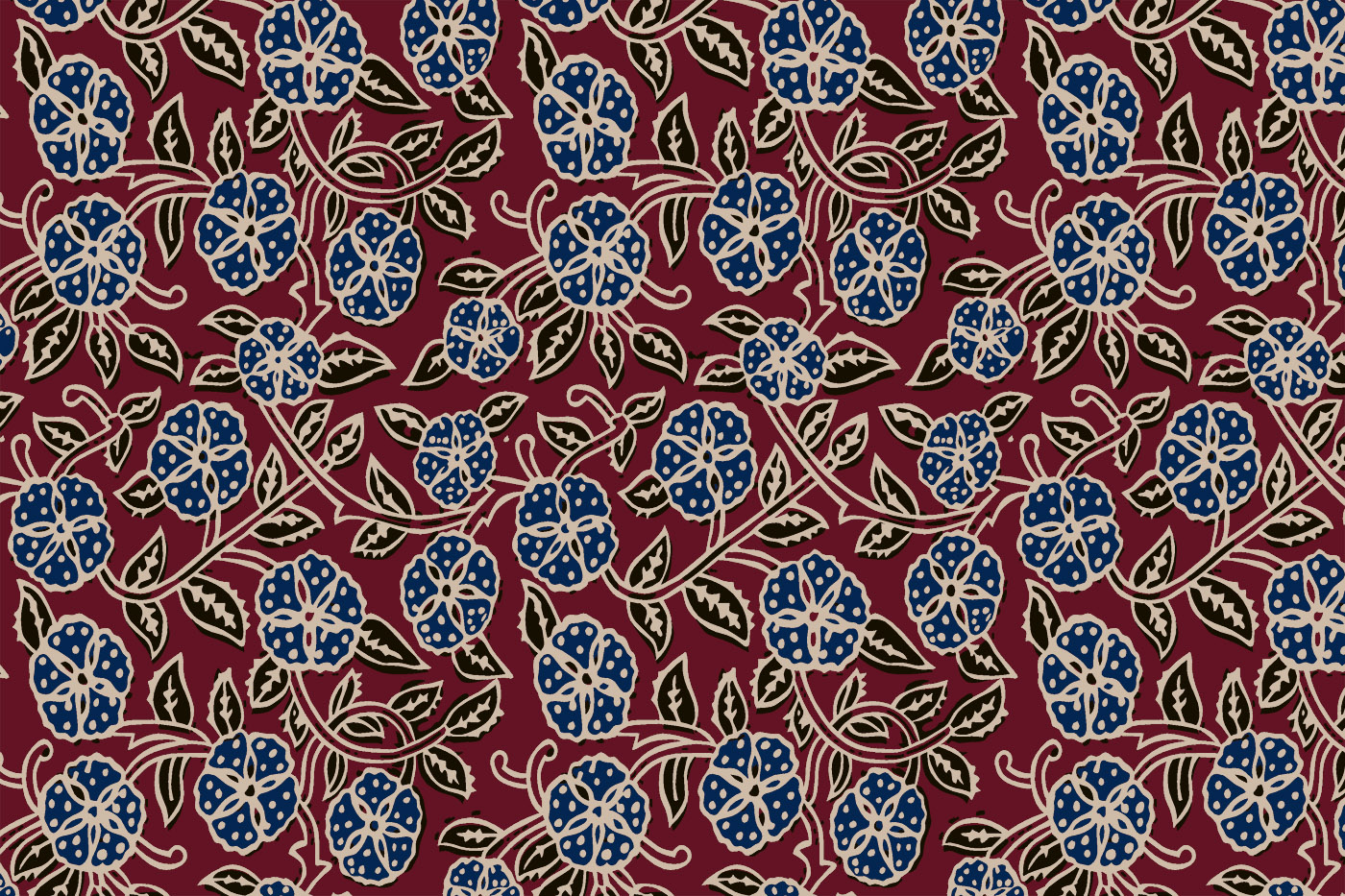
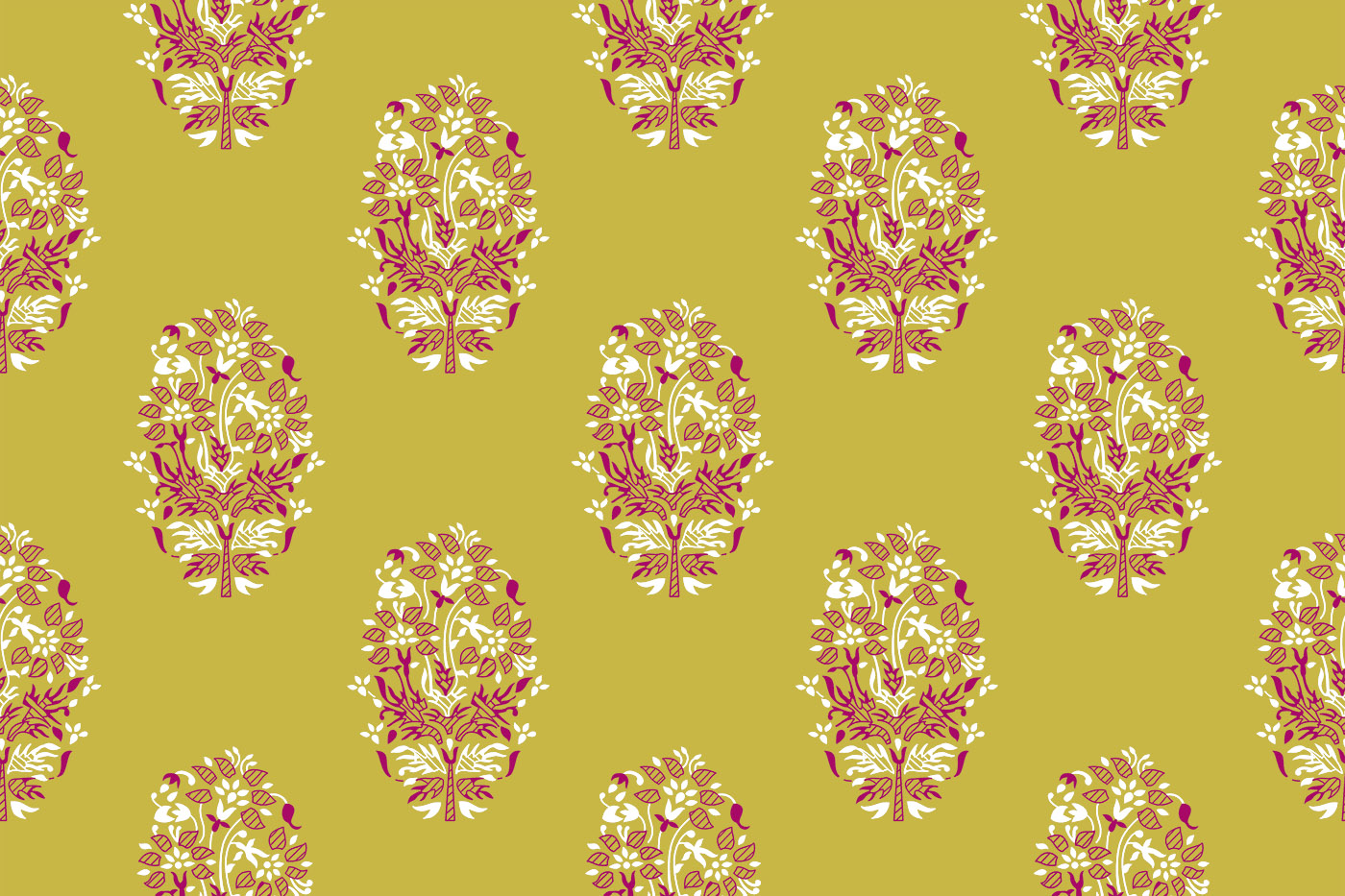
What if a textile pattern could carry the character of a hand-carved block, a balanced repeat and the visual warmth of traditional Indian printing?
Earthy reds. Deep blues. Mustard. Green. Natural neutrals. Floral and botanical motifs arranged into balanced repeats that feel handcrafted and rhythmic.
Bagru is one of Rajasthan's well-known hand-block textile traditions, associated with the Bagru craft region near Jaipur. Its visual identity is built around hand-carved wooden blocks, repeated impressions, floral and botanical motifs, butti arrangements, borders and colour combinations that give fabric a distinctly handcrafted character.
This article explores the distinctive character of Bagru printing, the block-printing workflow that creates it, the motifs and repeat structures that define Bagru-inspired patterns, and how contemporary designers can work with production-ready textile designs.
What Makes Bagru Printing Different?
Four defining characteristics help distinguish Bagru-inspired textile patterns from ordinary surface prints.
◆
Deep Blue
Deep blue remains one of Bagru’s signature colours. Traditional indigo dyeing, often fermented in clay or copper vessels, gives the fabric its characteristic depth and luminosity.
◈
Repeat Structure
Butti, floral, botanical and geometric arrangements are repeated across the fabric to create a balanced textile surface with rhythm and continuity.
▣
Natural Colour Direction
Traditional Bagru is strongly associated with natural-looking colour stories and earthy combinations. Contemporary Bagru-inspired designs can reinterpret the same motif language in wider palettes.
☰
Hand-Printed Character
Repeated block impressions create the characteristic handcrafted surface. Small variations in pressure and registration can become part of the visual character of hand printing.
How Bagru Is Made — The Journey of the Fabric
Traditional Bagru production is a sequential hand-printing craft. Exact methods vary between workshops, fabrics, dyes and designs, but the following stages illustrate the core workflow.
1
Preparing the Fabric
Fabric is washed and prepared to remove impurities and improve its ability to accept the printing and dyeing process. Preparation varies according to the fabric and workshop.
2
Block & Colour Preparation
The printing blocks, dyes, pigments or resist materials are prepared according to the intended motif and colour sequence. Traditional Bagru workshops may use natural dyes and locally established recipes.
3
First Block Impression
The carved wooden block is positioned carefully and pressed onto the prepared fabric. Repeated impressions build the motif and establish the foundation of the repeat.
4
Black / Charcoal
Additional block impressions can establish outlines, small details and contrast within the floral, leaf or geometric motif.
5
Colour 2
Colour is applied in the required sequence so each motif remains visually distinct. Traditional and contemporary workshops may use different dye or pigment systems.
6
Deep Blue
Each subsequent block must register correctly with the previous impression. Accurate placement is important when building an all-over repeat across a larger fabric width.
7
Prepareing & Sun Drying
After printing and colour development, the fabric is washed or finished according to the process being used and then dried. This reveals the final colour balance and print character.
8
Repeating the Pattern
Additional rounds of resist, printing, dyeing and washing may be performed. The final Bagru pattern emerges only after these successive layers have been completed. Traditional documentation frequently describes the complete cycle as comprising roughly 14–16 stages.
The Bagru Printing Journey at a Glance
A simplified visual summary of the sequence that transforms prepared fabric into a finished Bagru-style textile pattern.
Prepared Fabric
→
Prepare
→
Block Setup
→
Block Print
→
Black / Charcoal
→
Colour 2
→
Deep Blue
→
Prepare
→
Repeat
→
Bagru
Government and craft documentation from Kachchh commonly describe Bagru as a process of washing, dyeing, printing and drying involving approximately sixteen stages, depending on design complexity and workshop practice.
Why Bagru Has Those Famous Colours
Bagru-inspired textile designs are often associated with earthy, warm and natural-looking colours, while contemporary digital collections can reinterpret the same motifs in modern colourways.
Deep Blue
Deep blue character — the signature ground that gives Bagru its name association with “azrak” (blue).
Colour 2 / Madder
A warm heritage-inspired tone that adds depth to floral and butti repeats.
Black / Charcoal
Dark outlines and details help define small motifs and give the repeat a stronger graphic structure.
Natural / Off-White
Light grounds provide breathing space and make detailed floral or botanical motifs easier to read.
The Repeat Structure Behind Bagru
Bagru patterns are built on precise symmetry and repeating units that reward careful observation.
Motif → Repeat → Jaal → Border
- Symmetrical motifs — stars, medallions and floral forms organised around central axes.
- Jaal (net) — continuous all-over repeats that create a lattice-like surface.
- Borders — carefully proportioned edges that frame the main field.
- Block registration — each successive colour or resist must align accurately with the previous impression.
- Repeated units — the same carved block is used repeatedly, demanding consistent pressure and placement.
Why Bagru Hand Block Printing Requires Precision
An artisan must place each wooden block with exact registration. A slight misalignment becomes visible across the entire length of fabric. Traditional Bagru documentation emphasises the importance of skilled block carving, careful paste preparation, and the ability to maintain consistency through multiple stages of printing, dyeing and washing. The same block is often used for both sides of bipuri (double-sided) cloth, further increasing the demand for accuracy.
This precision is one reason authentic hand-block Bagru commands respect — and why modern production-ready digital files that capture the same geometric language are so valuable to designers who need reliable, scalable results.
Bagru Today — From Traditional Cloth to Modern Textile Design
Bagru-inspired motifs can move naturally between heritage clothing, contemporary fashion, garment manufacturing and surface-pattern applications.
Traditional & Fashion Uses
- Dupatta & Stoles
- Kurta, Kurti & Apparel
- Dresses & Ethnic Sets
- Scarves & Accessories
Modern Textile Applications
- Fashion prints and seamless repeats
- Garment panels and placement designs
- Home textiles (bed linen, curtains, upholstery)
- Contemporary surface design and digital textile printing
Ready-to-Print Bagru Designs — Time and Cost Saved
Creating a complex Bagru-style pattern from scratch — whether by traditional block methods or full digital recreation with proper layer structure and colour separations — can easily occupy a designer for 8–10 hours, and in many cases one to two full working days.
DesignShatter supplies production-ready Bagru-inspired textile designs as organised PSD files with editable colour channels. Files are delivered at high resolution (typically 300 DPI), ready for screen printing or digital textile printing. Designers can download a design, make light adjustments to colour, scale or motif placement if required, and move directly into production — often within minutes rather than days.
Pricing for individual designs is kept accessible (commonly in the low-dollar range), so the cost of acquiring a finished, print-ready file is a fraction of the labour required to build an equivalent pattern from zero. The platform records hundreds of Bagru-category downloads daily; the design team continuously releases new motifs across traditional and contemporary fields so that textile, fashion and surface designers can keep their collections current without repeatedly investing large blocks of time.
8–10 hrs Design development time reduced
$1–10 Accessible individual design options
200–300+ Daily Bagru-style downloads
5–10 min Quick colour customisation
Bagru Designs for Modern Textile Projects
Looking for Bagru-inspired textile designs that are already production-ready?
Frequently Asked Questions
What is Bagru?
Bagru is a traditional Indian (primarily Kutch, Gujarat) and Sindhi hand-block printing and resist-dyeing technique characterised by deep indigo, red, black and white, geometric and floral symmetry, and a multi-stage process of printing, dyeing and washing.
Where did Bagru printing originate?
Bagru printing is associated with the Bagru craft region near Jaipur in Rajasthan, where hand-block textile printing developed as an important local craft tradition.
How is Bagru printed?
Bagru textiles are printed using carved wooden blocks. The block is repeatedly stamped onto prepared fabric in a planned sequence, with colour, repeat registration and finishing determined by the workshop and design.
What colours are commonly used in Bagru?
Bagru-inspired designs commonly use earthy reds, deep blues, mustard, green, black, off-white and other heritage-oriented tones. Contemporary designs can expand the palette considerably.
How many stages are involved in Bagru printing?
There is no single fixed number of stages for every Bagru workshop or design. The workflow can include fabric preparation, block preparation, printing, colour application, drying, washing and finishing, with the exact sequence varying by process.
Is Bagru hand block printed?
Yes. Authentic traditional Bagru is produced with hand-carved wooden blocks. The same geometric language is now also interpreted in digital, production-ready files for modern printing methods.
What is resist printing in Bagru?
The carved block carries the motif or pattern element and is pressed onto the fabric repeatedly. Accurate block placement, repeat spacing and consistent pressure are important to the finished textile.
Where can Bagru textile designs be used, and are ready-to-print files available?
Bagru-inspired designs are suitable for apparel, home textiles, accessories and surface design. DesignShatter offers production-ready PSD files with editable channels so designers can download, adjust lightly if needed, and print via screen or digital methods without rebuilding the pattern from scratch.
Latest Post


